Showing posts with label DaimlerTrucks. Show all posts

Friday, 20 November 2026

Scania, MAN and Mercedes-Benz lead Truck Test 2026

Scania, MAN and Mercedes-Benz lead Truck Test 2026

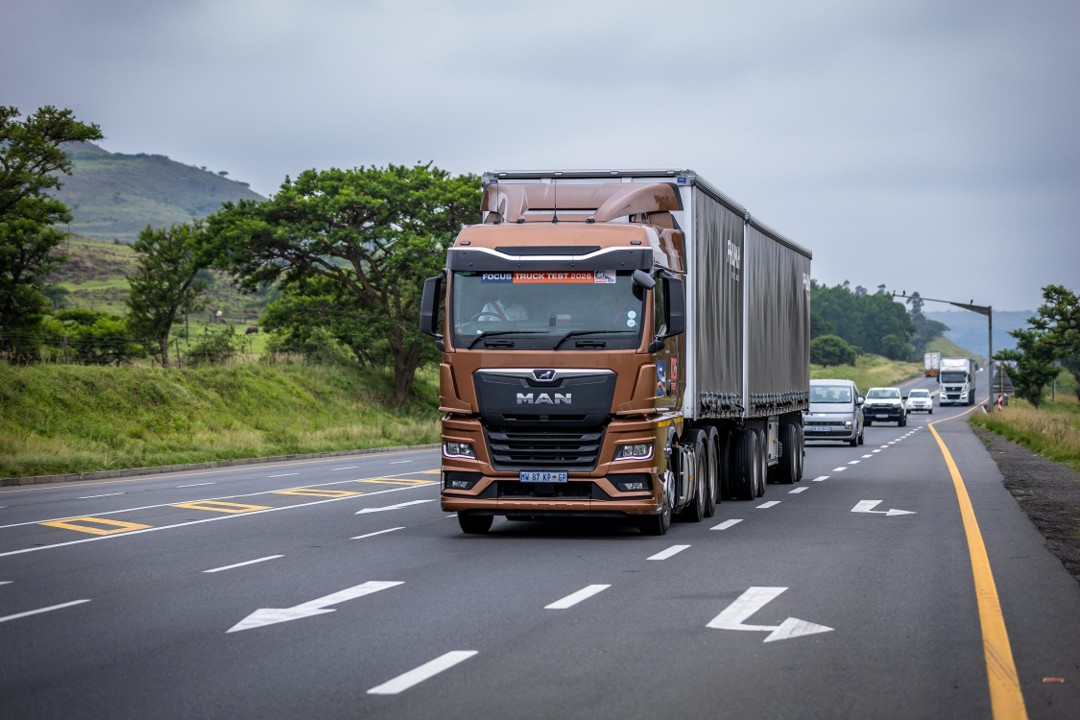
The demanding and often hectically busy N3 route from Johannesburg to Durban provided the ideal proving ground for the largest and most comprehensive truck test ever staged on the African continent with 19 equally laden interlinks making the trip down and back again in the 2026 Focus on Transport Truck Test.

Strictly monitored by C-Track telematics with fuel and oil tested for contaminants before and after the run by Wear Check, the results provide an insight to what it actually means to transport good around the country.

While fuel consumption is always a factor in transport costs, a much more significant indicator for fleet operators is the Payload Productivity Factor calculated thus: Payload Productivity Factor = payload (tons) x Ø speed (km/h) / (Ø fuel consumption (ℓ/100km) + Ø AdBlue consumption (ℓ/100km) x (AdBlue price (20.00).

The most fuel-efficient truck in this year’s Focus Truck Test used 43,47 litres of diesel per 100 km, while the thirstiest consumed 61,85 litres over the same Johannesburg to Durban and back route, carrying a near-identical load. For a long-haul operator, that difference is large enough to separate a profitable fleet from a struggling one.

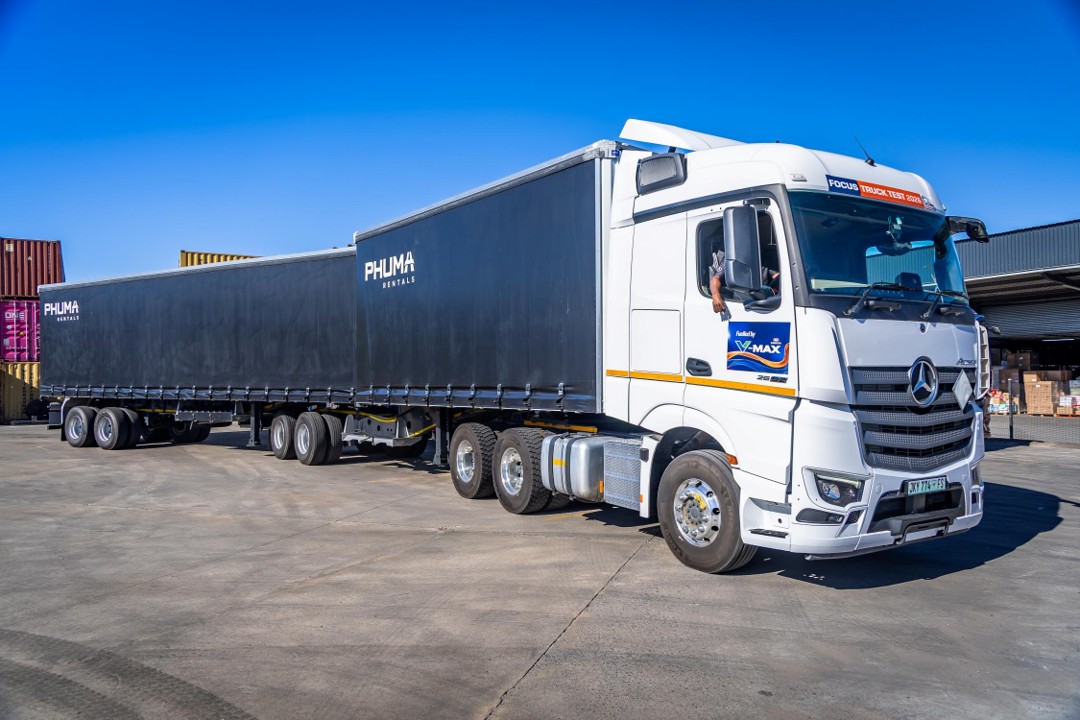
Truck Test 2026, powered by Engen and organised by Focus on Transport & Logistics, brought together 19 extra-heavy trucks from 13 manufacturers. Each 6x4 truck tractor pulled an identical Afrit tautliner trailer combination at a gross combination mass of about 56 tonnes, and all the vehicles ran on diesel supplied by Engen to keep fuel specification out of the equation. TruckScience handled data collection and analysis, with technical oversight from Truck Test Technical Director Jayesh ‘Tiny’ Daya.

Productivity and economy at the top

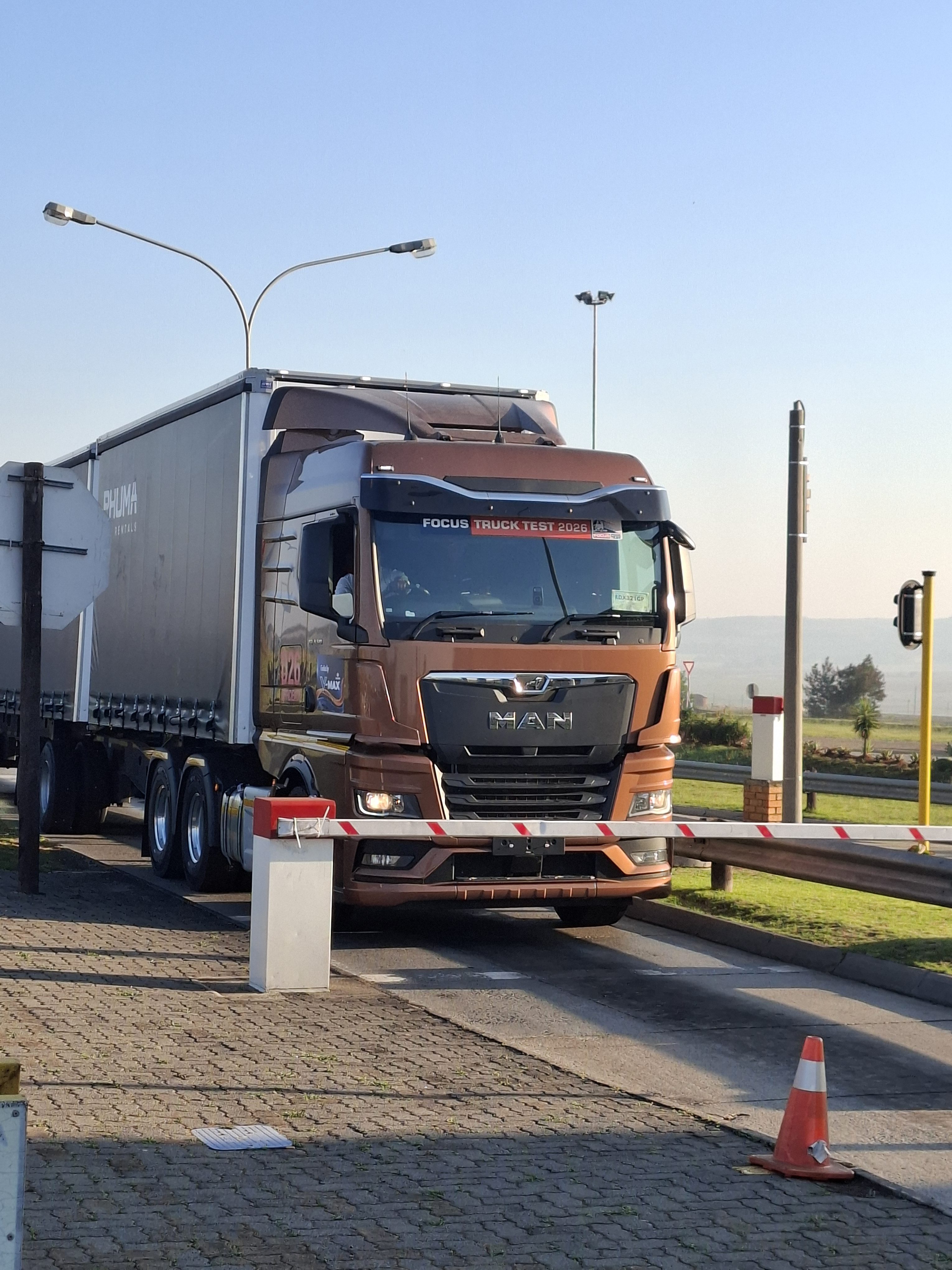
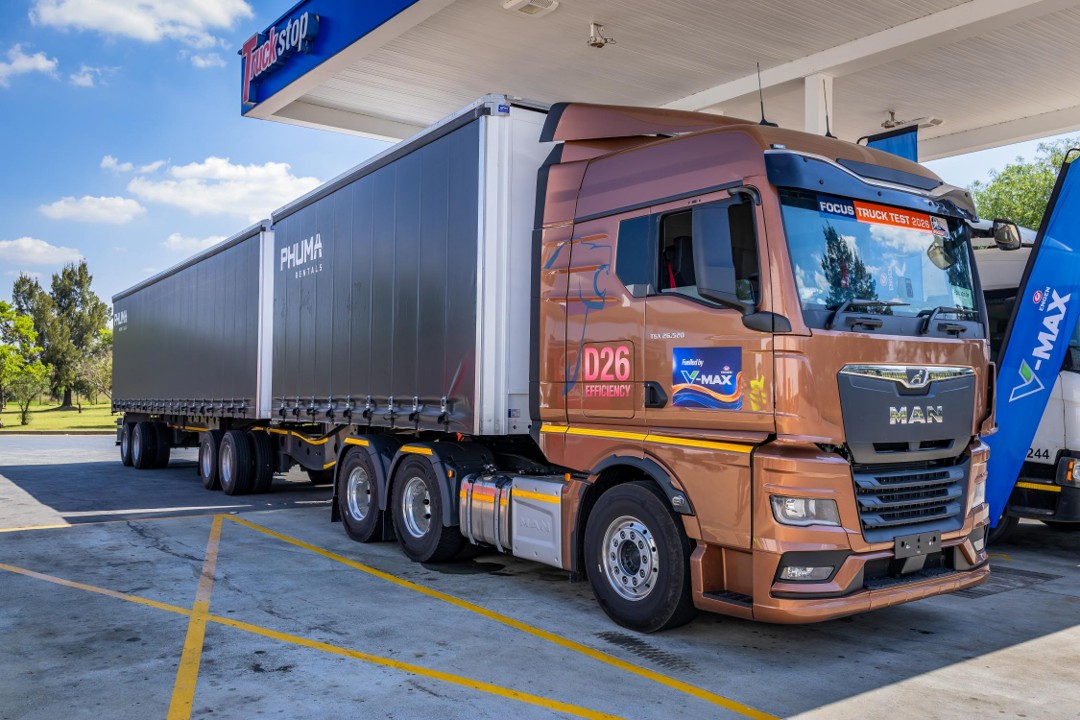
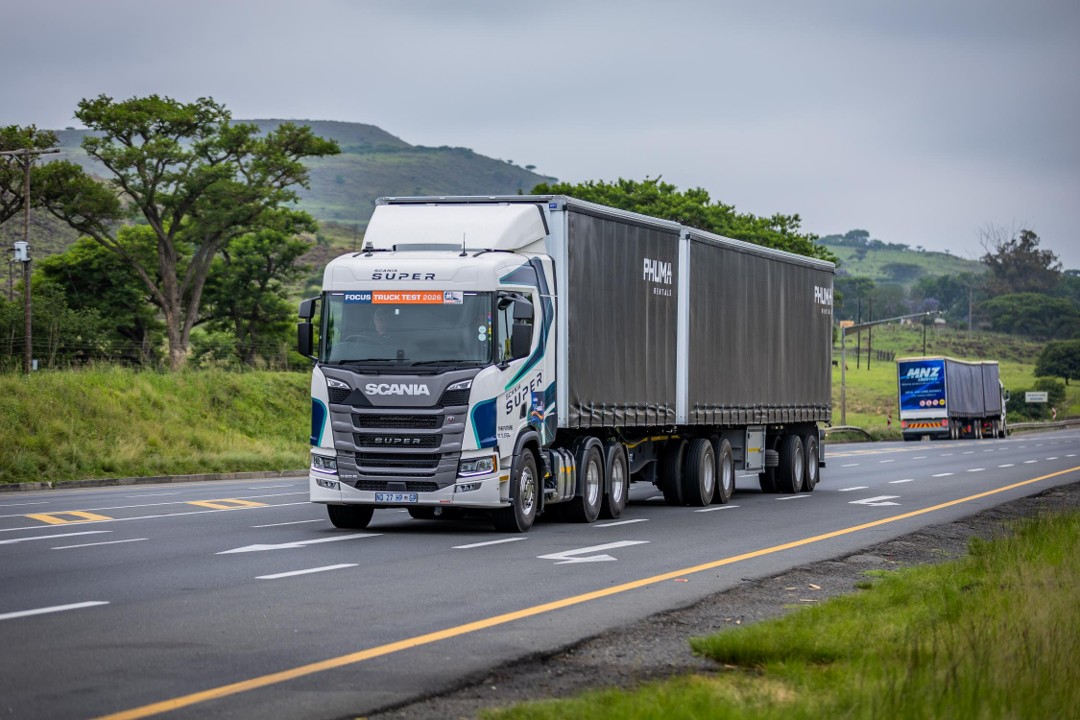
The published results, which cover actual rather than simulated runs, rank trucks on payload productivity, a measure of how effectively a vehicle turns fuel and time into delivered freight. The MAN TGX 26.520 BL SA GM finished first with a score of 48,9 and burned 45,22 l/100 km, the second-best consumption figure recorded. The Mercedes-Benz Actros 2652LS HT took second place on productivity at 45,9, though its consumption of 49,87 l/100km sat mid-table. The Scania R520 A6X4NA was third at 44,9 and posted the third-lowest consumption at 45,78 l/100km.

The lowest consumption of all belonged to the Scania R550 A6X4NZ at 43,47 l/100 km, which also had the highest torque in the field at 2 800 Nm. It ranked only 11th on productivity, however, with a score of 40,9. The result suggests that frugality alone did not carry the day, and that journey times and average speeds counted heavily in the productivity ranking.

The 56-tonne combinations carried payloads that varied by less than a tonne across the field, from 35 951 kg for the Iveco S-Way to 36 926 kg for the Sinotruk Howo-Max. Because loads were so closely matched, the differences in fuel consumption can be attributed largely to the trucks themselves rather than to what they were hauling.

Power on paper, efficiency on the road

The figures also challenge the assumption that more power means better performance. The Foton Auman 560 Air AMT, with 412 kW, was among the most powerful trucks entered, yet the two Foton variants finished last and second last on productivity and recorded the highest consumption, at 59,12 and 61,85 l/100km. The only difference between them was the axle ratio, and the variant with the 3.083 ratio used 2,73 l/100km more than the 2.846 version.

However, Foton did issue a statement saying incorrect settings for operating software were found post event and wind deflectors were not correctly set on both trucks – both of which were new with very low mileage that may have added to the fuel consumption figures.

Variants of the same model produced different outcomes elsewhere. The MAN TGX Euro 5 derivative used 49,13 l/100 km, almost four litres more than the standard MAN TGX, and scored 44,3 on productivity. The Mercedes-Benz Actros RE variant consumed 52,71 l/100 km against 49,87 for the HT and the Volvo FH520 (51,84 litres) used more fuel than the Volvo FH500 (49,66) despite its higher output designation.

The Iveco S-Way had the highest peak power in the test at 413 kW and returned 49,96 l/00 km, placing it sixth on productivity at 43,9. Chinese-built entries such as the Shacman X6000, FAW J7 and Sinotruk Howo-Max were spread between 49,36 and 53,58 /100km, with the FAW J7 28,550 recording the best consumption of that group.

What the gap means in rand terms

Engen illustrated the stakes with simple arithmetic. A truck covering 150 000 km a year that saves one litre per 100 km burns 1 500 litres less diesel annually, which at an illustrative R30 a litre is R45 000. Across a 100-vehicle fleet, that becomes R4,5-million.

Applying the same assumptions to the test results shows how much the choice of truck can matter. The 18,38 l/100 km separating the best and worst consumption figures would amount to roughly 27 570 litres a year per truck, or about R827 000 at R30 per litre. Even the 1,75 litre difference between the MAN TGX, the productivity leader, and the Scania R550, the consumption leader, represents about R78 750 per truck each year.

Sharveen Maharaj, Commercial General Manager at Engen, said the impact reaches well beyond transport operators. “Most people don’t think about trucks when they look at the price of their groceries, but almost everything we consume has been transported by road at some point,” he said. “Every litre of diesel has a cost, and those costs don’t stop with the transport operator. They work their way through the supply chain.”

A route that punishes engines and brakes

The Johannesburg to Durban corridor was chosen partly because of how hard it works a vehicle. Jim Ward, CEO of Jim Ward Consulting, described conditions that can change dramatically within a single day of driving. A truck can leave a cool, overcast coastal town at sea level at 18 degrees, travel five or six hundred kilometres inland and climb 1,6 kilometres in altitude, only to arrive in the Free State at more than 34 degrees.

“Heat lowers air density and oxygen reduces with altitude. That’s the double whammy,” Ward said, drawing a comparison with aviation, where hot and high conditions are among the most demanding for take-off. He said an intercooled turbo diesel helps, but with roughly 15% less oxygen available, the engine control unit still has to balance boost and fuel, and factors such as stop-start traffic, reflected road heat and exhaust gas recirculation alter the heat balance further.

“A combination that is comfortably powered at the coast, he noted, can struggle to pull away on a gradient from a standstill on a hot day at 1 600 metres, and in some conditions the route pushes engine management and braking systems close to their limits.”

Beyond the league table

For Maharaj, who drove part of the route himself, the exercise carries a broader message. “It carries someone’s business, whether it could be a small business or a big business. It carries someone’s livelihood,” he said of the country’s trucking sector, pointing to the roughly 400 000 trucks on South African roads and the millions of people who depend on them.

He argued comparative testing helps operators think differently about their businesses. “In transport, every kilometre, every litre, every inch of a tyre that is used creates a burden of cost for the business and for the economy at large,” he said. Truck Test, in his view, moves the conversation from manufacturers’ claims to measured performance. “It puts trucks to work under real operating conditions and generates meaningful data that fleet owners can use when making purchasing decisions.”

For fleet buyers, the results point to a simple conclusion: the figures on a specification sheet are a poor guide to what a truck will do on the N3 with 36 tonnes behind it.


https://bit.ly/4zqPAgt

Monday, 22 June 2026

Milestone Achieved: 150,000th Mercedes-Benz Truck in East London

Milestone Achieved: 150,000th Mercedes-Benz Truck in East London

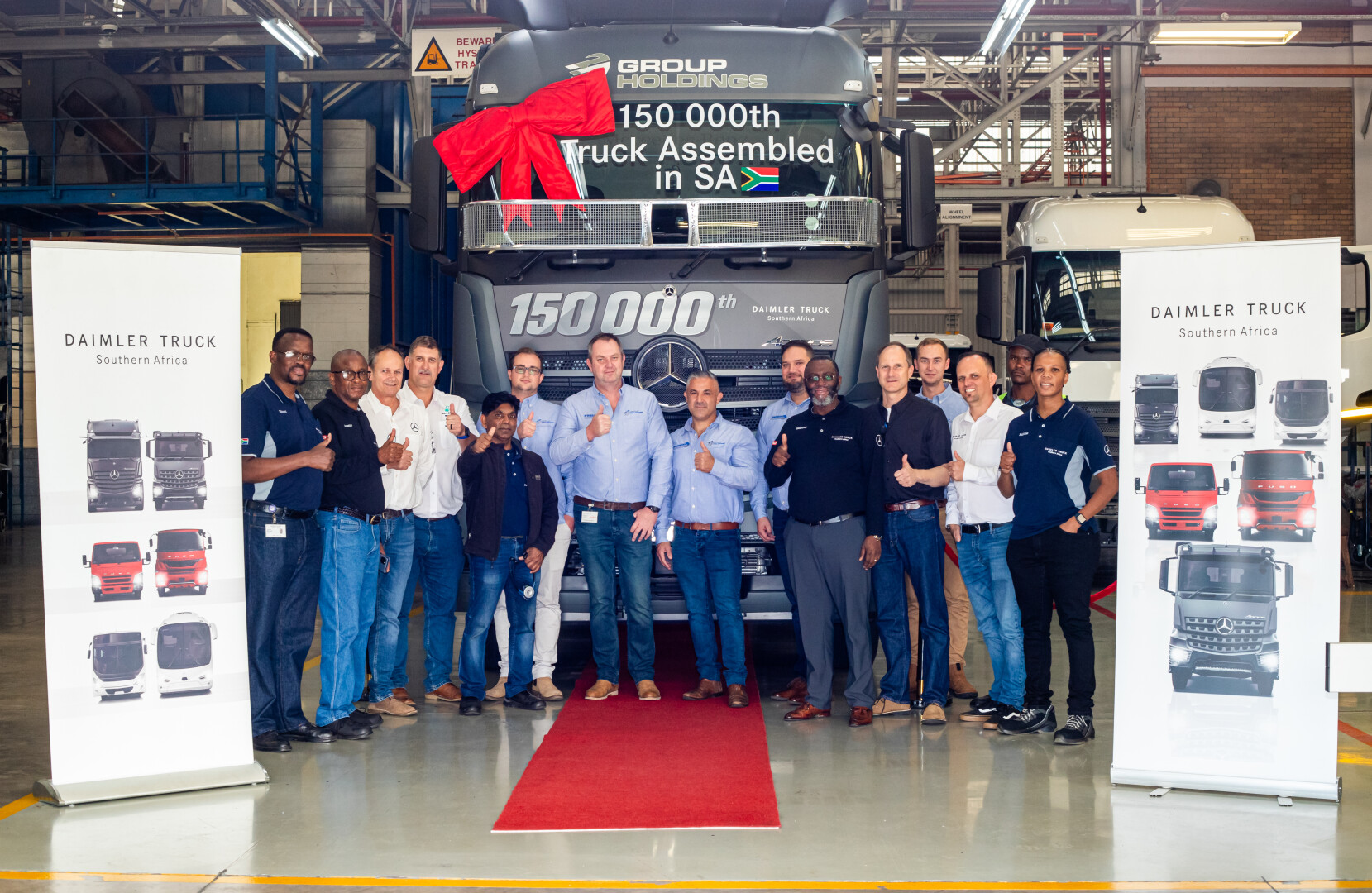
Daimler Truck Southern Africa (DTSA) has reached a production landmark at its East London (KuGompo) assembly plant with the handover of its 150 000th locally manufactured vehicle, a Mercedes‑Benz Actros 2645LS/33. The milestone unit was delivered to TT Group Holding during a ceremony at the facility, underscoring the long-standing relationship between the manufacturer and the transport operator.

Olaf Petersen, Vice President for Sales and Marketing at DTSA, described the occasion as a reflection of the company’s approach to customer engagement. “The trucking industry is built on strong, enduring relationships. We don’t simply hand over a truck; we partner with our customers and support them throughout their journey.

"It is especially meaningful to deliver our 150 000th locally built truck to TT Group Holding, a valued customer who shares our commitment to performance and excellence. This milestone is not only a reflection of our product strength, but of the trust and collaboration that drive our business and the business of our customers forward,” he said.

The journey of local truck production in South Africa began more than six decades ago, when the first L-Type Mercedes-Benz Truck rolled off the same East London line in 1962. That event marked the start of both Mercedes-Benz truck assembly in the country and the broader establishment of local commercial vehicle manufacturing. The latest production figure reinforces the plant’s continued relevance in delivering transport solutions tailored to regional conditions, while also supporting localisation targets, employment, and skills development.


Gladstone Mtyoko, Vice President of Manufacturing at DTSA, highlighted the role of the workforce in achieving the production figure. “The production of our 150 000th truck at the DTSA assembly plant represents far more than a number; it is a testament to the dedication, craftsmanship and passion of our people.

It reflects the strength of our production capabilities and our relentless focus on quality, efficiency and continuous innovation. This milestone demonstrates the important role we play in powering mobility and keeping Africa moving. I am incredibly proud of this achievement and of the outstanding team behind it, who continue to set the standard for excellence in manufacturing. Sibhiyoza kunye – sikunye siqhubekekela phambili ekugqweseni,” Mtyoko said.

The East London plant has marked several notable achievements over the years. In 2010, it assembled Mercedes‑Benz OH bus chassis in support of the FIFA World Cup hosted in South Africa. Five years later, the facility produced its 125 000th truck.

More recently, the plant contributed to broader Daimler Truck production networks with the assembly of the 750 000th CKD unit in 2019 and the 800 000th unit from the Wörth plant in 2024. In 2023, Mercedes‑Benz Trucks commemorated 25 years of the Actros model in South Africa, alongside its local assembly history. The current celebration in 2026 also coincides with international milestones, including 130 years since the first Mercedes‑Benz truck, 30 years of the Actros in Europe, and 80 years of the Unimog.

Looking ahead, DTSA indicates that it will continue to invest in its production processes, product development, and personnel, with the aim of adapting to the changing demands of the transport sector while maintaining its manufacturing footprint in the region.

https://bit.ly/4eonPxX

Thursday, 27 November 2025

Tip Top Milk Expands Fleet with 21 New Mercedes-Benz Trucks

Tip Top Milk Expands Fleet with 21 New Mercedes-Benz Trucks

Boosting its national logistics operations, Tip Top Milk has rolled out 21 new Mercedes-Benz Actros 2645 trucks, a move that solidifies a 15-year partnership and underscores the dairy giant's relentless growth. This latest investment brings its total fleet of the German marque to an impressive 155 vehicles, all dedicated to the crucial task of transporting fresh milk from farm to processing plants across South Africa.

The company's journey is a classic South African success story. It was founded in 2010 by the late Beyers de Bruin with little more than steadfast faith, a single Dyna 3500 milk tanker and a mission to assist farmers burdened with milk surpluses. Today, that vision has blossomed into a major enterprise operating from three depots nationwide. Tip Top Milk now employs around 200 people and is responsible for sourcing, collecting and moving a staggering 36-million litres of quality milk every month.

According to David de Jager, Chief Executive Officer at Tip Top Milk, this remarkable expansion has never come at the cost of the company's core values. "Our business is, and always has been, built around people—our customers and our employees. We pride ourselves on doing what is right and being honest in everything we do."

Relationship

This people-centric philosophy extends to their choice of equipment. The relationship with Mercedes-Benz Trucks began at the very start, when the fledgling company needed a partner that believed in its potential. "Back in 2010, Mercedes-Benz Trucks was the only brand willing to take a chance on us," de Jager recalls. "That’s where Beyers’ love for the brand started."

That initial trust has been fortified over the years through a close working relationship with Mercedes-Benz Trucks and Motus Daimler Trucks Airport. De Jager is quick to praise the support from Ruan Pienaar and his team. "Their support is unwavering, and they never make excuses. It’s a pleasure doing business with them," he adds.


In the high-stakes world of perishable goods transport, reliability is non-negotiable. Tip Top Milk has found this in the durability of their Mercedes-Benz trucks, particularly their powertrains. The fleet even includes a vehicle that has clocked over a million kilometres. "But no matter how reliable a truck is, repairs will eventually be needed," de Jager notes. "That’s where Mercedes-Benz Trucks truly stand out—the availability of parts makes all the difference and keeps our business moving."

Dealer Network

This commitment to uptime is backed by an extensive dealer network that provides Tip Top Milk with critical peace of mind. De Jager points out that on one of their major routes alone, there are at least two dealerships ready to assist. He shares a recent incident that highlights this exceptional service: "We contacted Motus Daimler Trucks Airport on a Saturday afternoon with an urgent need to replace a truck after an accident. By Tuesday, the new truck was delivered. That level of responsiveness is a testament to their commitment."

To further optimise operations, Tip Top Milk utilises the Fleetboard vehicle management system. This technology is integral to their drive for fuel efficiency and enhanced driver performance. The company has built a driver bonus structure around the data provided by Fleetboard, leading to tangible results. Through targeted training and data-driven feedback, the average driver performance score has climbed from 8,9 in 2014 to 9,4 today, delivering significant savings on fuel and maintenance.

For de Jager, the decision to stick with the brand goes beyond specs and service. "Mercedes-Benz Trucks are not only the most aesthetically pleasing on the road, they offer a host of features that support our operations," he says. "But the most important factor is our people. Our drivers spend countless hours behind the wheel, and their comfort directly affects their performance and well-being. That’s why we choose Mercedes-Benz Trucks: they deliver unmatched comfort, helping us take care of the people who keep our business moving."

Vision

Reflecting on the enduring partnership, Olaf Petersen, Vice President of Sales and Marketing at Daimler Truck Southern Africa, said, "Fifteen years ago, we saw their vision and potential, and today we’re proud to be one of the leading brands behind their business. We sincerely thank David and the entire Tip Top Milk team for their loyalty. Their continued trust inspires us to support their business as it grows from strength to strength."

As Tip Top Milk celebrates a decade and a half of operation, the arrival of the 21 new trucks is more than a simple fleet refresh; it is a powerful reaffirmation of a partnership built on a foundation of mutual trust, proven performance, and a shared commitment to keeping South Africa's dairy industry flowing.

https://bit.ly/4oe2d93

Thursday, 22 August 2024

Daimler Truck achieves production milestone

Daimler Truck achieves production milestone

Daimler Truck Southern Africa (DTSA), the East London-based truck assembly plant, marked a significant achievement recently by officially rolling off the 800 000th Completely Knocked Down (CKD) kit from its parent factory in Woerth, Germany.

The vehicle, a Mercedes-Benz Actros 2645LS/33, emerged from the assembly line in a joint celebration with the Woerth source plant in Germany. Sesfigile Logistics and Safety One Logistics, both owned by Nelen Gounder, purchased the truck to commemorate their respective 20th and 10th anniversaries.

The Woerth plant, founded in 1963, is Mercedes-Benz Trucks’ largest truck assembly facility. Here, the Actros, Arocs, and Atego model series take shape. Additionally, Woerth produces the battery-electric Mercedes-Benz eActros 300/400 for distribution haulage, along with the eEconic electric series-production truck for municipal use. The eActros 600, designed for long-distance haulage, is set to enter series production by the end of 2024.


The East London assembly plant boasts a storied history spanning six decades. From the first Mercedes-Benz Truck in 1962 to thousands of trucks and buses today, the plant remains a cornerstone of the Buffalo City Metropolitan Municipality.

Employing around 300 people, it ranks among Daimler Truck’s largest CKD-plants outside Europe. In 2019, DTSA assembled its 750 000th CKD unit, a Mercedes-Benz Actros 2652 LS 6×4.

Gladstone Mtyoko, Vice President for Manufacturing, acknowledged the complexity of assembling products from four different source plants on a single production line. Despite this, the team consistently delivers high-quality units. The assembly of the 800 000th CKD truck stands as a proud milestone for both the Woerth and local East London plants.

Sesfigile Logistics commands a fleet of 200 trucks, specializing in beverage and petroleum transportation. Its reach spans local, national and cross-border logistics, while. Safety One Logistics, grounded in precision and efficiency, handles petroleum and specialized products with care.


https://bit.ly/4dWJjz3

Wednesday, 24 April 2024

Daimler Truck committed to driver wellbeing

Daimler Truck committed to driver wellbeing

Daimler Truck Southern Africa (DTSA) is deeply committed to the wellbeing of truck drivers and has made significant strides in improving their lives through a partnership with Trucking Wellness. Together, they have established multiple access points for primary healthcare including fixed roadside wellness centres, mobile units, and the Fleet Owner Workplace Wellness Programme tailored for DTSA key account customers.

Recently, Pool Transport became the 10th key account customer to successfully implement this wellness program under the aegis of the National Bargaining Council for the Road Freight and Logistics Industry (NBCRFLI) and its Trucking Wellness Project.


Launched in 2013, the DTSA Fleet Owner Workplace Wellness Programme targets all employees but focuses particularly on drivers, aiming to lessen the repercussions of diseases and health issues on the financial, operational, human resources, and overall ownership costs for fleet owners.

This program has evolved over 11 years, continually adapting to meet the changing needs of its customers. This year, Pool Transport spearheaded several enhancements, including aligning the program with RTMS accreditation, the creation of the first fatigue management policy, and the development of a medical certification process for truck drivers.

Dirkie van Zyl, Managing Director of Pool Transport, expressed his gratitude and commitment following the completion of the program. He emphasized the company's dedication to driver wellness and safety, acknowledging the shared responsibility in contributing to safer roads.

Benefits

Tertius Wessels, Managing Director of the Corridor Empowerment Project which manages Trucking Wellness for the NBCRFLI, highlighted the benefits of their 15-year partnership with DTSA. This collaboration has fostered deeper relationships with transport firms such as Pool Transport, enhancing the effectiveness and reach of wellness programs and services.

Maretha Gerber, President and Group CEO of DTSA, reinforced the company's dedication to advancing healthcare access for truck drivers in South Africa.

“DTSA remains committed to advancing access to primary healthcare for truck drivers in South Africa, because we know a healthy truck driver is a safe truck driver, contributing to safer roads for all South Africans. DTSA’s Fleet Owner Workplace Wellness Programme is one of the vehicles to achieve this goal and I am thankful for partners such as Trucking Wellness and Pool Transport for their efforts and commitment to complete this programme and make a lasting impact towards this amazing cause.” 


https://bit.ly/3w6nLQ5

Wednesday, 26 April 2023

Colin-on-Cars - Daimler Truck opens new headquarters


Colin-on-Cars - Daimler Truck opens new headquarters

Although it has been operating as an independent company for some time, the transition of Daimler Truck Southern Africa was formalised this week with the official opening of its purpose-designed headquarters and campus near Pretoria.

The 12-hectare site houses the main offices, training centre, used and new vehicle retail facilities and a dedicated Daimler Truck Financial Services company.

Karin Rådström, Member of the Board of Management Daimler Truck AG, and CEO of Mercedes-Benz Trucks, says: “I am excited to be part of the DTSA headquarters’ inauguration, re-affirming our commitment into one of our strategic markets in Africa.


Karin Rådström

“The investment not only underlines our positioning as a global player in the commercial vehicle world, but also shows our keen passion for people and the diversity for which South Africa is renowned. The new headquarter sets the team up properly to serve our customers in this very important market for Daimler Truck.”

The opening of the new facility follows a pledge made by Daimler Truck to invest R190-million in South Africa – R170-million going to the building that consumed 180 000 bricks during construction and R20-million used to update facilities on the truck line at the Mercedes-Benz manufacturing site in East London.

Michael Dietz, President and CEO of Daimler Truck Southern Africa Ltd added: “As a team, we are truly humbled by how far we have come since becoming an independent company on December 1, 2021.

“This day marks a great beginning for us and I look forward to further creating a great place to work for our employees, while fully catering to our customers and continuously serving all who keep Africa moving.

“The setting up of this remarkable establishment commenced in quarter one of 2021 and entailed the procurement of the campus, refurbishment of the existing offices, the addition of a dedicated DTSA training facility and notably the construction of the new Daimler Truck Southern Africa headquarter offices.”


Michael Dietz

The new premises were officially opened by Ms Nomalungelo Gina; Deputy Minister of Trade Industry and Economic Development for the Republic of South Africa, Karin Rådström; Member of the Board of Management Daimler Truck AG and CEO of Mercedes-Benz Trucks, Stephan Unger; Member of the Board of Management Daimler Truck AG and Head of Financial Services, Andreas Peschke; German Ambassador to the Republic of South Africa/eSwatini/Lesotho, Andreas von Wallfeld; Head of Daimler Truck Overseas, Michael Dietz; President and CEO Daimler Truck Southern Africa, together with the DTSA Board of Directors.

“The new headquarter is a welcoming home for our team in South Africa. The concept of bringing sales and marketing and Financial Services together under one roof, is taking the right step in our strategy to provide integrated transport solutions for our customers,” says Stephan Unger.

Andreas von Wallfeld, Head of Daimler Truck Overseas, had this to say; “I am very proud of our new home for our team here in South Africa. Having an all-encompassing commercial vehicle campus taking care of all aspects of our business is a benchmark and a truly customer-centric approach.”


With 600 employees across the campus, the DTSA headquarter and TruckStore facilities were designed with a clear intention of creating a sustainable and comfortable workplace with features such as facades and windows screened to limit solar heat gain, while reducing electrical loads.

High-specification low-E double glazing further ensures low heat gains and losses. The roof slopes to the north to allow for future solar installation and rainwater collection on one facade. Parking bays and roof areas are utilised to generate electricity and reduce reliance on non-renewable sources while 752 solar panels provide 350 kWp electricity.


https://bit.ly/3LyjA4E

Monday, 16 January 2023

Colin-on-Cars - Global hub for spare parts

Colin-on-Cars - Global hub for spare parts

A truck fleet is only as good as its service backup and Daimler Truck has re-organised its spare parts logistics by opening a new global supply hub in Halberstadt, Saxony-Anhalt, Germany.

As the heart of the global supply of spare parts, a completely new logistics hub – the so-named Global Parts Center and, in the future parts deliveries will be made from this central location, eliminating additional transport routes and cutting the time until parts are available.

The new logistics hub will deliver up to 300 000 different items – from the smallest screw to a finished truck cab – to almost 3 000 vehicle dealers in 170 countries around the world. The Global Parts Center thus will make an important contribution to ensuring the international flow of goods.

Thanks to state-of-the-art storage and conveyor technology, all vehicle parts will be available for immediate retrieval in an automated high-bay warehouse and an automated small parts warehouse. Construction is scheduled to begin this year, with commissioning scheduled 2028.

Contribution

Karin Rådström, CEO Mercedes-Benz Trucks, says “Halberstadt and the Global Parts Center will play a key role in the future: Spare parts from our new logistics hub will make a significant contribution to keeping our customers and their trucks up and running, thereby delivering on our ambition ‘Trucks you can trust’.”

Jörg Howe, General Representative Daimler Truck AG, responsible for Global Communications & External Affairs, added “Our new Global Parts Center is the biggest logistics project in our company's history. In the future, the Halberstadt site will play a crucial role in keeping our trucks running and thus our economy and society. Without trucks, factories stand still and supermarket shelves remain empty.”

About 2 600 Mercedes-Benz Trucks’ suppliers will provide the logistics hub with their parts in the future so Halberstadt will become the heart of the worldwide supply of spare parts for Mercedes-Benz Trucks. Fuso parts supply in Europe will also be handled by Halberstadt in the future.

In a three-stage logistics process, the new location will serve around 20 regional logistics centres worldwide – in, for example, various European countries, Turkey, the United Arab Emirates, Brazil and China – which in turn will supply regional dealers with parts.


In the first stage of expansion, the new building in the East Industrial Park in Halberstadt will have a gross floor area of around 270 000 square metres with around 260 000 square metres of logistics space. Up to 450 qualified jobs will be created on site. After further construction stages and the assumption of additional activities in connection with global parts logistics, up to 600 jobs will be created at the site.

Energy

The new logistics location is planned from the start for CO₂-neutral operation; the energy concept completely dispenses with fossil fuels. Neither natural gas nor oil is required. The location will be heated with electric heat pumps that bring heat into the building via underfloor heating systems. Due to the low heating water temperatures and the storage effect in the industrial floors, a high level of energy efficiency will be achieved.

In addition, it is intended to equip the roofs with photovoltaic systems, which can generate up to 13-million kWh of electrical energy per year. This is more electricity than will be consumed at the site. Surplus energy from the Global Parts Center will be made available to other Daimler Truck locations in Germany. The roofs of the outbuildings will be greened.

Employees will be provided with a large number of charging stations for e-vehicles and e-bikes. Appropriate charging options will also be available for suppliers’ trucks, whose fleets are gradually being electrified.


https://bit.ly/3kfWbcS

Wednesday, 10 November 2021

Colin-on-Cars - New dawn for Daimler Trucks

Colin-on-Cars - New dawn for Daimler Trucks


Michael Dietz

Daimler Trucks & Buses Southern Africa (DTBSA) will operate as a wholly independent business operation from December 01 as a dedicated commercial vehicle operation with its own finance company – and is investing R1-billion in doing so.

Mercedes-Benz will be a separate company looking after passenger cars and vans but manufacturing and assembly for both will remain at the East London production plant.

The separation is in line with the global direction being taken by Daimler AG and Michael Dietz, President and CEO DTBSA says: “This is indeed a massive turning point for us as DTBSA and a huge investment for the Southern Africa market. We have done some ground-breaking changes previously, like the establishment of DTBSA as a legal entity in 2019 and more recently the founding of our very own captive financial mobility services, Daimler Trucks Financial  Services (DTFS).

“I firmly believe the new set-up promotes the necessary focus into our core business, creates favourable conditions for us to be more competitive and accelerates the development of key technologies for us to continue to provide cutting-edge products and services to fulfil the special needs of our customers.

“It is without a doubt this independence is fully aligned with our growth strategy and further strengthens our foothold within the markets we operate in. As we gear up to a smooth transition, our commitment for all who keep Africa moving remains unchanged.”

An investment of up to R1-billion has been made available to ensure continuity in operation, adequate resources, and suitable working infrastructure for the DTBSA business. This new set-up will comprise of the Sales and Marketing, Customer Service & Parts (CSP), Own Retail, Manufacturing Plant, Value-added services which include; TruckStore, FleetBoard, Mercedes-Benz Uptime, Service24h, TruckParts, and FUSO Value Parts (FVP).

Building of a new corporate home in Centurion, Pretoria is scheduled to start soon and bring together all the facets of the new company with the exception of the manufacturing arm, which will will have the same level of access to the key production areas such as harbour, depots/storage centres, testing ground, and Training Academy as Mercedes-Benz.

Looking to the future, Dietz confirmed the fully electric eCanter was undergoing testing in real world operating scenarios with selected customers but added DTBSA would offer a balanced portfolio of product within the expanding electric vehicle sphere with combustion engines offered whenever a conventional powertrain is a key requirement.

Hanif Ahmed, the Chief Financial Officer for DTBSA added: “The aim is to provide unrivalled and dynamic products for our customers along with holistic solutions for both dealers and customers, all of which is driven by service delivery.”


https://bit.ly/3ks5UKe