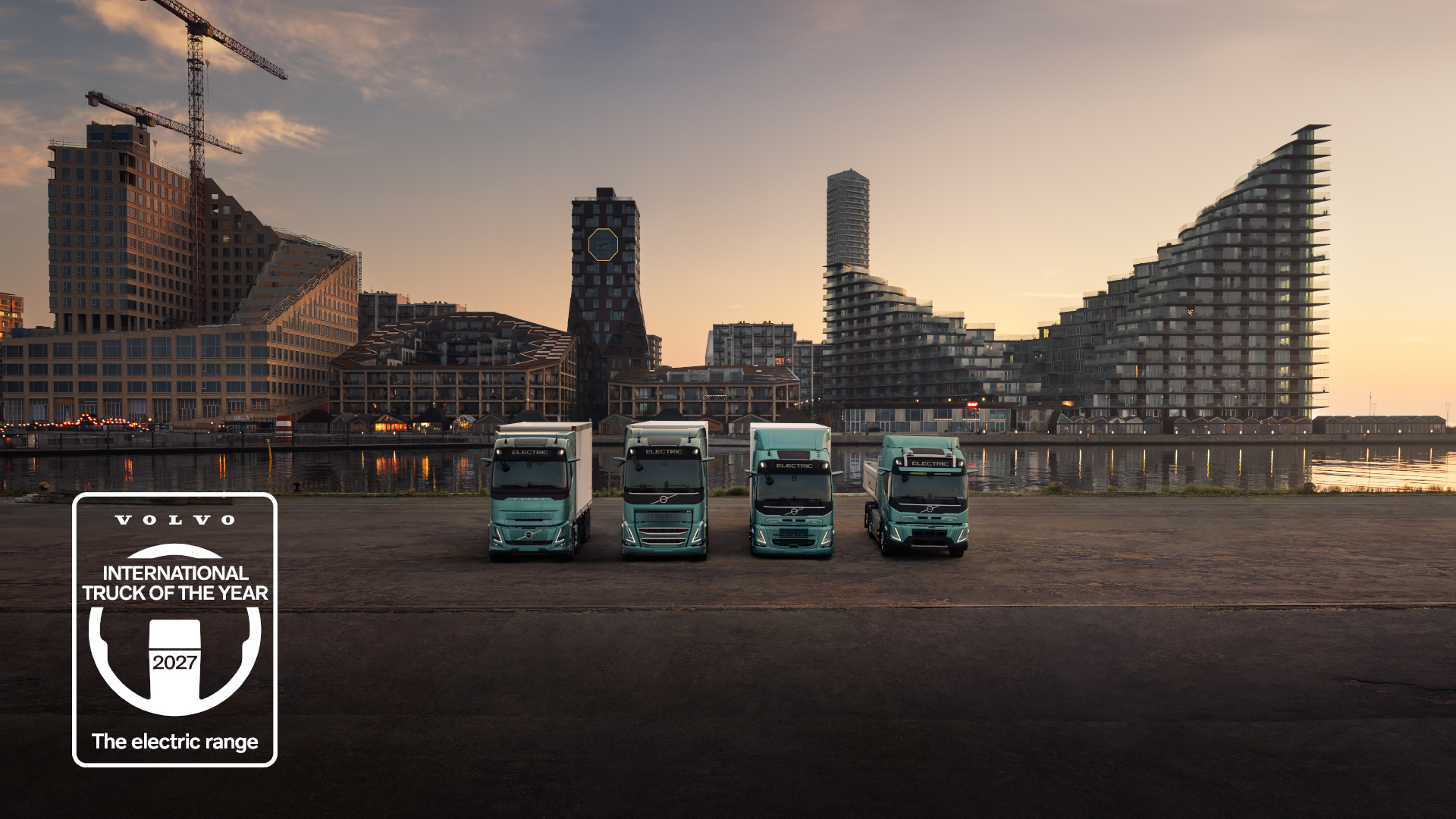
Volvo Trucks has received an international industry award for its electric truck range. The recognition marks the company’s eighth win of the accolade and the second time its FH Electric model has been named International Truck of the Year. The award acknowledges electric transport as a workable option across a growing number of applications.
The heavy-duty electric line-up, which includes the Volvo FH, FM, FMX Electric and FH Aero Electric, was selected as International Truck of the Year 2027. According to the company, the range offers a driving distance of up to 700 km, along with improved payload capacity and shorter charging times than earlier models. It is intended for regional and long-haul transport, city distribution, construction and utility work.
The jury noted how Volvo has expanded its electric portfolio beyond a single vehicle or use case. It highlighted the combination of longer range, different cab and chassis configurations, and various solutions that can be adapted to different transport tasks.
Florian Engel, chairman of International Truck of the Year, said the winning range represents a significant development in the company’s battery-electric heavy-duty offering. He added that it shows how quickly battery-electric heavy-duty transport is shifting from individual applications towards a broader transport solution.
Roger Alm, president of Volvo Trucks, received the award during a ceremony at IAA Transportation in Hanover, Germany. He said the recognition confirms the company’s position in electromobility and noted strong demand for the new electric trucks, with the order book almost full. According to Alm, the range allows more operations to choose transport with zero tailpipe emissions.
Since 2019, 7,000 electric Volvo trucks have covered 500 million kilometres worldwide. Close to 2,000 customers in more than 50 countries currently use electric Volvo trucks in their daily operations.
Volvo Trucks offers eight electric truck models designed for a range of transport assignments. Over seven years of electrification, the company has developed expertise in optimising energy usage, charging and service for electric trucks.
The International Truck of the Year organisation was established in 1977 and consists of 24 commercial vehicle journalists from major trucking magazines across Europe. The annual award goes to the truck introduced to the market in the previous 12 months that has made the most significant contribution to road transport efficiency. Judges assess criteria including technological innovation, comfort, safety, drivability, energy efficiency, environmental impact and total cost of ownership.
https://bit.ly/4htJvKo