
South Africa’s automotive industry stands to deepen its role in regional value chains following a renewed push by the African Continental Free Trade Area (AfCFTA) Secretariat to transform the continent’s vehicle manufacturing sector.
The commitment, announced at the inaugural Africa Automotive Investment Forum held on the sidelines of the Alamein Africa Business Forum in Egypt, calls for greater investment in local manufacturing, stronger regional supply chains and increased production of vehicle components across Africa.
For South Africa, already the continent’s leading automotive manufacturing and export hub, the timing is significant. The sector generated R270,8-billion in revenue from vehicle and component exports in 2023, a 19,1% increase on the previous year. Exports to African countries totalled 25 381 vehicles, pointing to considerable room for expansion under the continental trade agreement.
NegotiationAfCFTA Secretary-General Wamkele Mene told delegates with the automotive Rules of Origin now concluded, attention must shift from negotiation to implementation. “The focus now shifts from establishing the rules to translating them into investment, production and employment,” he said.
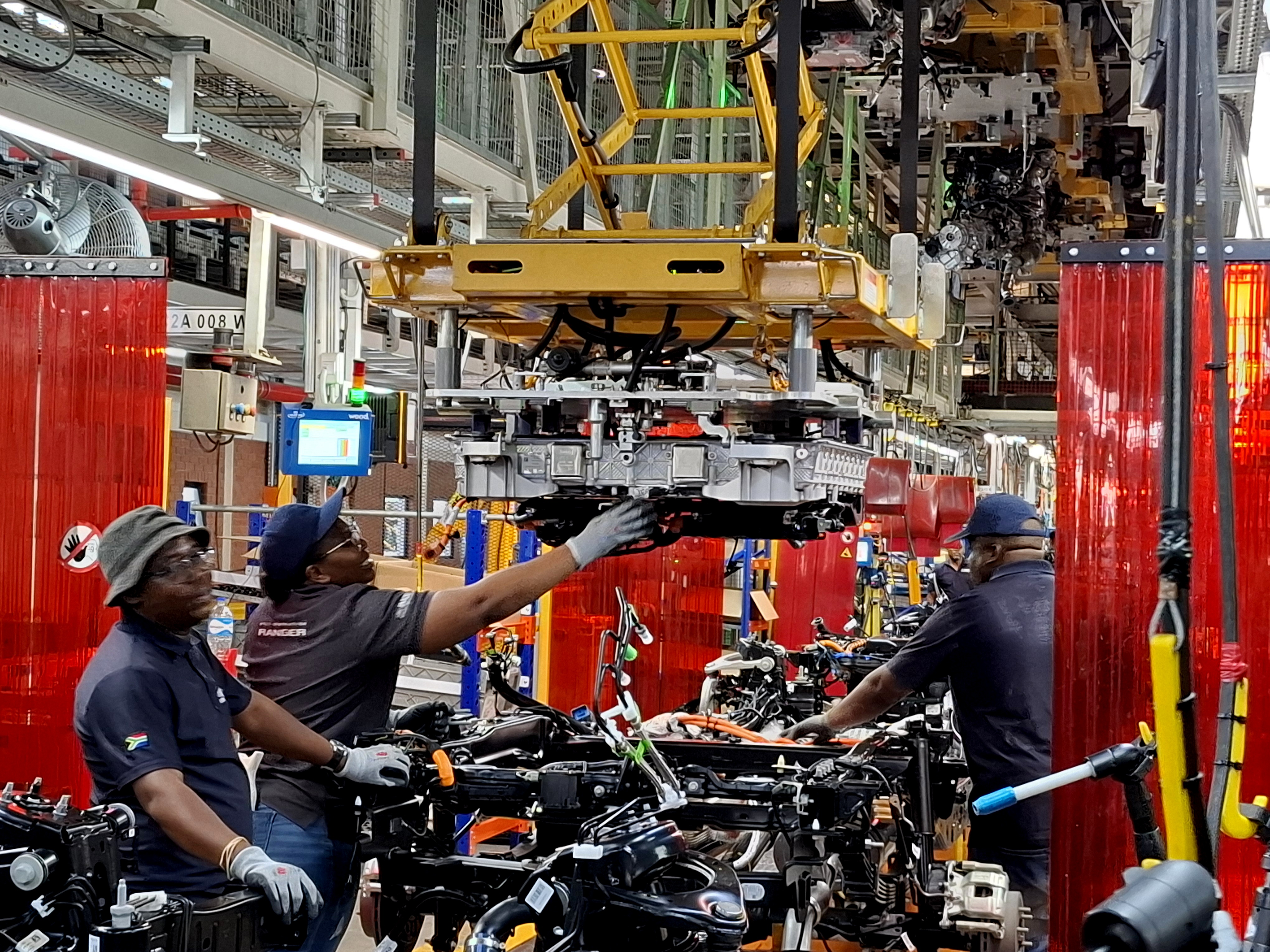
Battery insertion at Ford's Silverton plantMene outlined three priorities for advancing the Strategy for the African Automotive Sector: developing investment-ready projects and competitive production locations, strengthening regional supplier networks while deepening local manufacturing, and ensuring that automotive production across African markets becomes commercially viable.
A central aim is to forge stronger links between vehicle assembly plants and African manufacturers of essential components, including tyres, glass, plastics, textiles, electronics and batteries. Such integration is expected to open opportunities for South African firms to participate in regional production networks, increase local value addition and support the development of a competitive continental industry.
Mene also stressed the importance of improving customs procedures, transit arrangements, product standards and regulatory alignment to ease the movement of components and finished vehicles across African markets.
Resources
The strategic opportunity for Africa to leverage its mineral resources for domestic processing, battery materials production, component manufacturing and vehicle assembly was highlighted as a means of retaining a greater share of value generated from natural resources while promoting industrial development and employment.
In a development on the margins of the forum, the AfCFTA Secretariat and the African Association of Automotive Manufacturers (AAAM) signed a Memorandum of Understanding aimed at strengthening cooperation for the sustainable development of Africa’s automotive industry. The agreement, signed by Mene and AAAM President Tarek Mosaad, establishes a framework for collaboration on the Strategy for the African Automotive Sector, covering Rules of Origin, customs procedures, trade facilitation, regulatory standards, capacity building, supplier development, investment mobilisation and emerging automotive technologies.

It will also promote mineral beneficiation, enabling African countries to move beyond exporting raw materials towards higher-value manufacturing. Crucially, the agreement supports the AfCFTA Automotive Investment Plan being advanced with the African Export-Import Bank.
Mosaad, who is also President and CEO of Hyundai Motor Company Middle East and Africa, said Africa’s automotive industry is well positioned to attract new investment as the continent advances implementation of the 40% automotive Rules of Origin.
“The question is no longer whether Africa can build an integrated automotive industry but how quickly we can turn commitments and policies into factories, suppliers, jobs and tangible trade,” he said.
He identified three priorities: expanding regional supplier value chains, removing barriers to cross-border trade, and building capabilities in future mobility technologies such as electric vehicles, battery manufacturing and charging infrastructure.
Action PlanThe AAAM and AfCFTA MoU has already produced a joint action plan focused on implementation, including a dedicated Rules of Origin expert, a three-year skills development programme and a continental supplier database. Mosaad welcomed the agreement, noting that investors are not looking for 54 separate markets but one integrated opportunity.
“When Africa provides the right policy certainty, infrastructure and cooperation, it has the resources and capabilities needed to become a major global automotive manufacturing hub,” he said.
The upcoming Egypt-SACU Business Council is expected to support stronger trade, investment and industrial cooperation between the regions, further opening doors for South African manufacturers.
Domestically, the sector is undergoing significant change as manufacturers navigate increased global competition, evolving consumer expectations and the transition to new vehicle technologies. Industry leaders from government, manufacturing, finance and the broader mobility ecosystem have gathered in Durban for South African Auto Week 2026, hosted by naamsa | The Automotive Business Council. The platform facilitates high-level dialogue between industry and policymakers to shape regulatory frameworks, support local manufacturing and address sector challenges.
Charl Potgieter, Managing Executive of Absa Vehicle and Asset Finance, said the industry has always been one of South Africa’s strongest examples of what can be achieved when manufacturers, government, financiers and suppliers work towards a common goal.
Partnerships“In the environment we’re operating in today, those partnerships are becoming even more important. How do we attract investment? How do we remain globally competitive? How do we prepare for new technologies while continuing to create jobs, support localisation and drive economic growth? These are conversations the industry needs to have,” he said.
Potgieter added that the future of the industry will not be determined by any single manufacturer, policymaker or financier but by how effectively stakeholders work together.
Government’s commitment to localisation, transformation and the transition to new energy vehicles took centre stage at the opening session in Durban. Trade, Industry and Competition Minister Parks Tau outlined a vision of a prosperous and sustainable sector where transformation and competitiveness do not exist in tension.
“An industry that draws on all of its people, and on a broad and capable supplier base, is a stronger industry. It is more resilient to shocks, more responsive to its customers and more deeply rooted in the country that hosts it, and localisation is where transformation becomes real. Every imported component that we learn to make here is an opportunity for a new supplier, a new investment and new jobs,” he said.
Tau said government is putting instruments in place to ensure that emerging companies owned by previously disadvantaged citizens are not left behind in the transition to new energy vehicles.

“Batteries, electric drive units, power electronics, thermal systems and charging equipment are new value chains. They are still being built. Black and women-owned firms can enter them at the start, as owners and partners, rather than on the margins,” he said.
He reasserted the significance of the current review of the Automotive Production and Development Programme 2, stressing it must reward manufacturing in South Africa, not assembly alone, and must support component manufacturers. A 150% investment allowance now applies to qualifying investment in electric and hydrogen vehicle production, while the Automotive Investment Scheme, the Industrial Development Corporation, the National Empowerment Fund and other development finance institutions will continue to support investment in the supplier base.
Tau acknowledged the pressures facing component manufacturers, including imports, energy and logistics costs and weaker demand.
“Some have closed. We cannot speak about transformation without also speaking about keeping this base alive,” he said. To this end, government is pursuing the Africa Automotive Pact through AAAM and partners in Egypt and Algeria, a mechanism intended to give life to the AfCFTA and enhance diversification as new markets are accessed for growth.
 Local beneficiation of raw material is vital
The discussions and partnership signal a shift towards practical implementation of the continental trade agreement, with automotive manufacturing identified as an important pathway for industrialisation, economic diversification and regional integration.
By connecting Africa’s mineral resources, manufacturing capabilities, investment opportunities and expanding continental market, the AfCFTA framework offers a platform for building an increasingly integrated automotive industry.
The emerging priority is to ensure that agreed trade rules translate into functioning factories, competitive African suppliers, sustainable employment and greater participation by African enterprises in continental and global automotive value chains.
For South Africa, the message from Durban and Egypt is clear: the rules are in place, and the focus now is on delivery.
https://bit.ly/4yLwHFA

No comments:
Post a Comment