
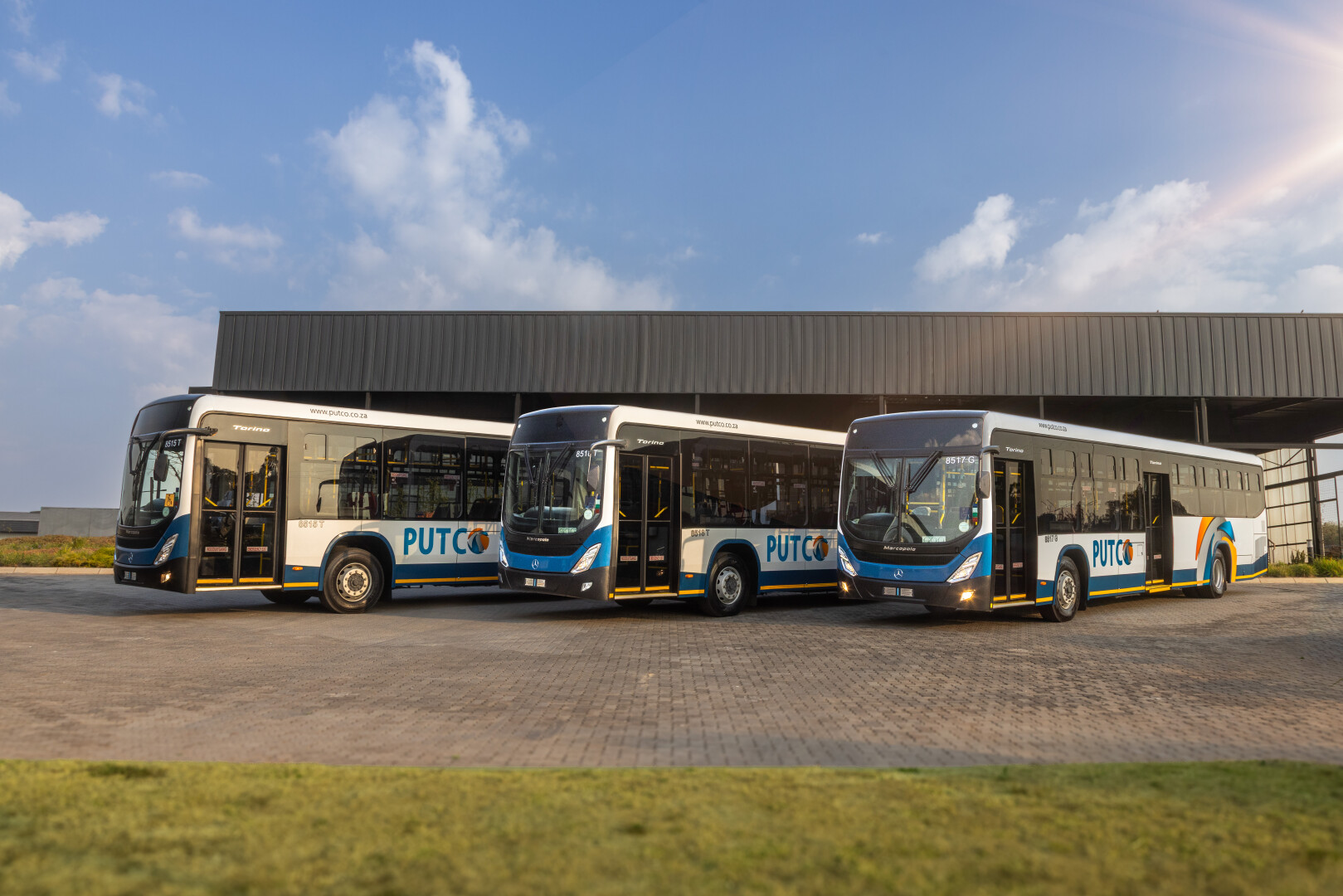
In a significant step towards inclusive public transport, Putco has taken delivery of six Mercedes-Benz Low Entry buses designed specifically with universal accessibility as a core principle from the outset.
The vehicles, built on the Mercedes-Benz OH 1826 LE Euro 5 Low Entry Bus Chassis and fitted with the Marcopolo Tourino G7 Low Entry Body, represent the first universally accessible buses to join the Putco fleet. Their design makes boarding and alighting considerably easier for elderly passengers, people living with disabilities, parents travelling with young children, and commuters with limited mobility.
The new buses come equipped with fitted ramps and dedicated space for wheelchairs, along with priority seating for passengers who may require it. The buses can also lower themselves closer to pavement level to further improve accessibility. Importantly, Putco engaged with organisations including the South African Disability Alliance and the National Council for Persons with Disabilities throughout the design process to ensure the vehicles responded to the real needs of passengers living with various disabilities.
"This handover is about more than delivering buses," said Deon de Vries, General Manager for Mercedes-Benz Buses in Southern Africa. "It reaffirms Mercedes-Benz Buses and Putco's shared commitment to delivering safe, dependable and customer-focused transport solutions that support South Africa's public transport network."

Franco Pisapia, Chief Executive Officer of Putco, described the occasion as a significant day for the company. "These low-entry buses are the result of a true partnership between an operator, a chassis manufacturer and a body manufacturer. What started as an idea evolved into a design, then a prototype, and today that prototype has become the foundation for a new generation of more accessible buses for Putco," he said.
The project is part of a broader trend in South Africa towards more accessible public transport. In the Western Cape, GO GEORGE has also made significant strides, with every bus in its fleet – whether mini, midi or standard – fitted with ramps or hydraulic hoists to ensure dignified boarding for passengers with mobility impairments. The service reports that passengers with disabilities make up 0,85% of total ridership, amounting to more than 4 000 trips monthly. Western Cape Mobility Minister Isaac Sileku has described accessibility as "not an add-on; it is a fundamental right”.
Putco already runs two buses accommodating people with disabilities in the Soshanguve and Mpumalanga regions, with the Mpumalanga bus transporting disabled learners to schools and the Soshanguve bus providing daily transport to the Tshwane CBD for work purposes.
Disability inclusion specialist Mandy Latimore, who took part in consultations, said the introduction of the buses marked a major step towards greater accessibility in public transport, while noting that truly accessible mobility also depends on infrastructure at bus stops, interchanges and destinations.
"For Putco, accessibility is not just about buses," Pisapia added. "It is about connecting people to opportunities and ensuring that no one is left behind”.
The six buses are expected to enter service on Putco routes shortly. The company, which transports more than 230 000 commuters daily across Gauteng, Mpumalanga and Limpopo, has not yet indicated which routes will be served by the new vehicles.
https://bit.ly/3UQ5tys

No comments:
Post a Comment